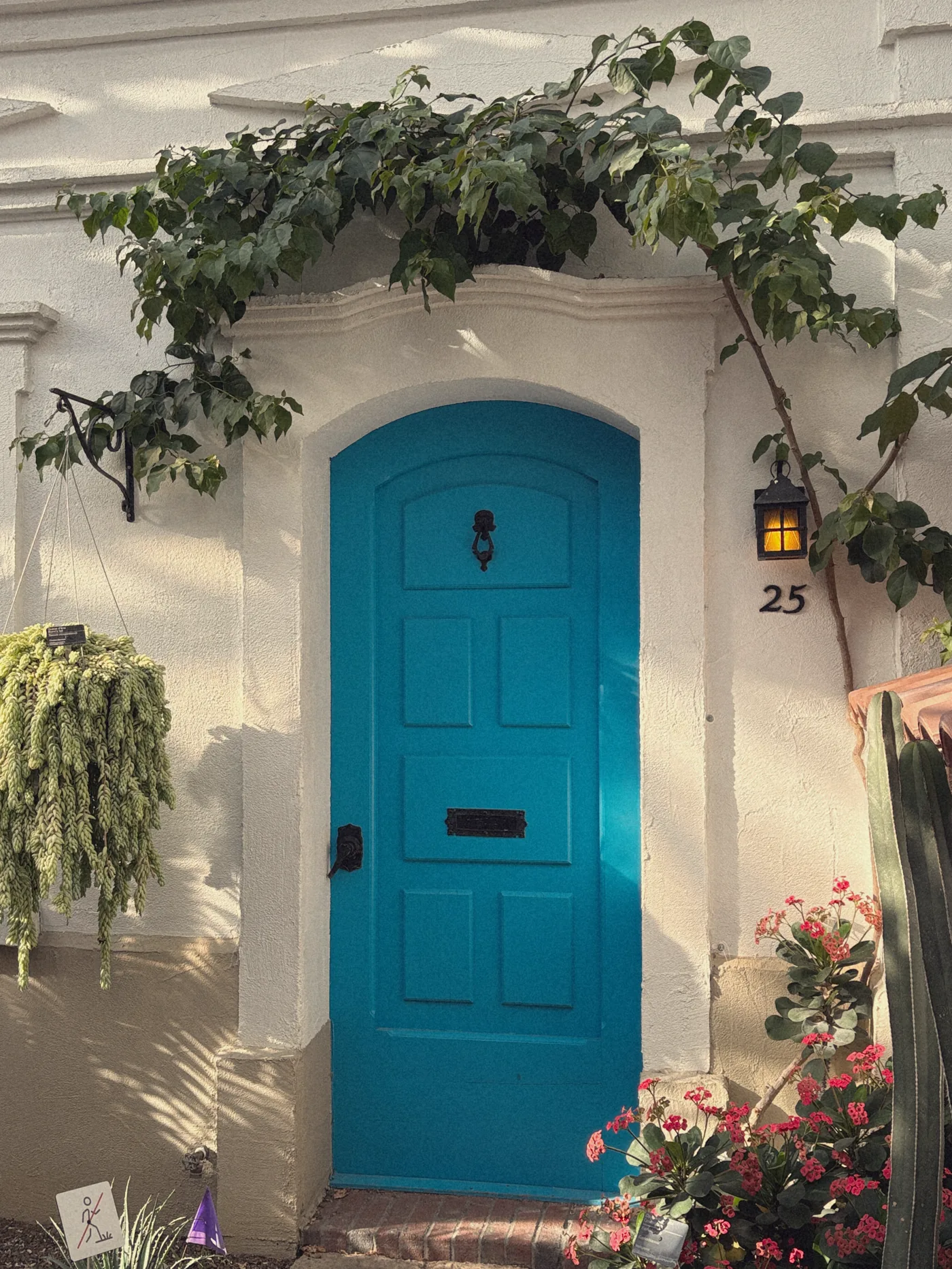
A door is a rectangle inside another rectangle, and a phone ought to be able to record the two without arguing. Often it does not.
The top of the doorway comes out narrower than the bottom, the wall leans like a tired fence, and the photograph makes a solid building look ready to fall over. Nothing is wrong with the building: the fault is in where the phone was pointing, and it comes in two versions that need different corrections.
The short answer
Vertical lines stay vertical in a photograph while the back of the phone is parallel to the wall. Roll the phone left or right and everything leans the same way; pitch it up and the top of the frame converges. Rolling can be fixed where you stand, in one gesture. Pitching is geometry: a steadier hand will not fix it, and the honest choices are to move back, change the lens, or correct in editing and spend pixels.
Two faults, one symptom
Roll is a rotation around the axis pointing at the wall. The frame tilts against the horizontal lines of the building, and every vertical in the picture leans by the same amount. Photograph the door with the phone five degrees off level and the whole facade leans five degrees.
Pitch is the top of the phone pulled back, so the lens looks upward. The sensor is no longer parallel to the wall, and each part of the facade projects at a size set by its distance from the lens plane. The top of the frame comes from the top of the building, which is farther away, so it is drawn smaller. Edges that are parallel in the stone converge in the photograph. Photographers call it keystone, after the wedge-shaped stone at the crown of an arch.
A doorway makes the arithmetic easy to check. Take a 2.1 m opening photographed from 1.5 m with the phone at eye height and pitched up ten degrees: the bottom of the opening sits 1.5 m below the lens, the top 0.6 m above it, and the projected widths come out as 1/1.22 against 1/1.58. The top edge lands roughly 23% narrower than the bottom. That is not a small lean; it is a trapezium where a rectangle used to be.
The same arithmetic explains why the widest lens makes it worse. At 0.5× the sides of the frame are fed by light arriving at a steep angle, and straight lines near the corners bow. For a facade, 1× and three steps back usually beat 0.5× and one step back.
The check that takes two seconds
Look at the wall edge and the frame edge together. If the gap between them is the same at the top and at the bottom, the vertical is straight.
If the gap grows steadily from one end to the other, the phone is rolled: a straighten in the Photos app fixes that in one gesture. If the gap grows only at the top, or the two sides of the opening lean towards each other, it is pitch, and straightening will not help.
What to do, cheapest first
- Stand square. Move sideways along the wall until the two side edges of the opening look the same width. If one jamb shows more of the wall thickness than the other, you are off-axis by that much, and no crop repairs it.
- Hold the phone level, and do not tilt it up. Grid and Level are switches in Settings, then Camera, as Apple’s camera tools guide describes. Keep the phone at chest or eye height and include the top of the door by stepping back, not by pitching.
- Pay for the step back. The door fills less of the frame: the same 2.1 m opening spans 66.8 degrees from 1.5 m, and 37.9 degrees from 3 m, so twice the distance costs 43% of its height on screen. What you buy is a frame that needs no correction.
- Correct in Photos, last. The crop tool can straighten a photo and tilt it vertically, which is exactly the convergent case (Apple’s crop and straighten guide). The correction reshapes the projection and crops what falls outside: a few degrees are invisible, ten degrees smear the stretched corner and quietly remove the top of the frame.
The exception that matters
Leaning is sometimes the photograph. Looking up the shaft of a tower, or standing a metre from a doorway so a room feels tall, the convergence is the subject: it says the camera was looking up, which is what a person does. The mistake is not leaning; it is leaning three degrees by accident and calling it perspective.
Second limit: a perfectly straight facade can look like a survey drawing. What repairs that is a foreground, a shadow or a reference for scale, not a return to the tilt.
Try it: one door, two minutes
- From about a metre away, pitch the phone up until the lintel touches the top edge of the frame, and shoot.
- Step back until the whole door fits with the phone held level at chest height, Level on, and shoot again.
- Take a third from the same spot with the phone at knee height.
- Compare: in which one do the door jambs stay parallel to the sides of the frame? In which one does the wall behind look tallest?
- Open the first in Photos, tilt it vertically until the jambs are parallel, then check what left the frame at the top. That missing strip is the price of the correction, paid in pixels.
BULB draws composition guides over the live frame and gives the reason for a crop in one sentence — the composition tools. If the wall itself interests you more than the lean, frame within a frame is the next question; if it is what surrounds the door, start with the distractions at the edges.